Author: Adrian Callen

  • How DOTS and Wilks Scores Work for Female Powerlifters

    How DOTS and Wilks Scores Work for Female Powerlifters

    You calculated your score and compared it to numbers online. Most of those numbers are for male lifters.

    Female powerlifters use the same scoring systems. But the formulas behind them are not identical.

    Do DOTS and Wilks use different formulas for women?

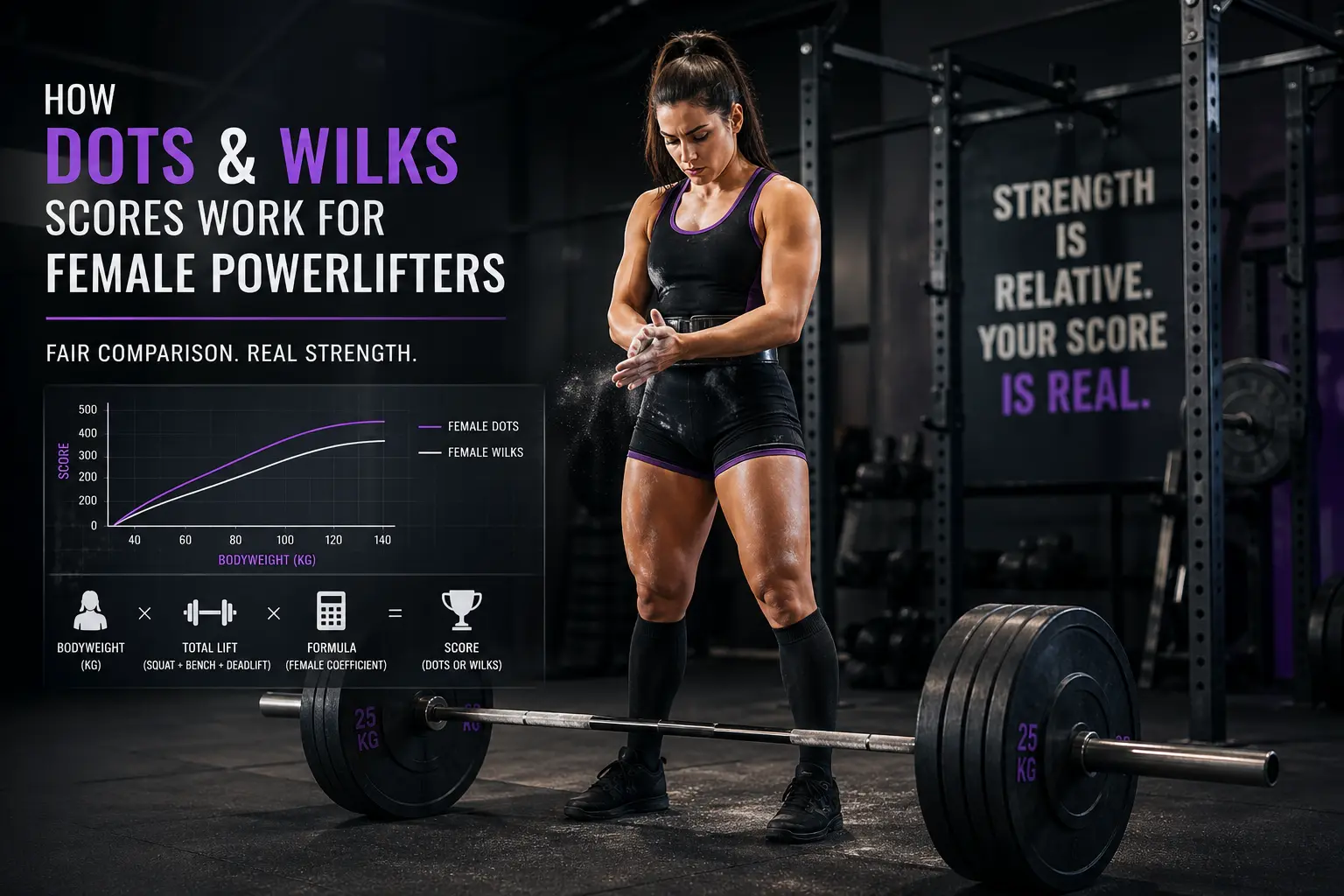
    Yes. Both DOTS and Wilks apply separate polynomial coefficients for female lifters. The constants in those equations differ from the male version. This reflects the real difference in how strength scales with bodyweight across sexes.

    Why do separate coefficients exist

    Male and female strength curves follow different patterns across bodyweight ranges. A single universal formula would systematically over- and undervalue female performances. Separate coefficients are used for men and women. They adjust for biological differences. Even with this adjustment, both scores stay on the same scale.

    Are female DOTS and Wilks scores comparable to male scores?

    Yes. The scoring scale is the same for both. A 350 DOTS from a female lifter represents the same relative strength level as a 350 from a male lifter. Both formulas are designed to make cross-gender comparison meaningful.

    What this means in practice

    A female lifter with a score of 380 DOTS and a male lifter with 380 are at the same level. Their strength is equal relative to their body size. Neither score is adjusted down nor inflated. The coefficient does the work of making both numbers land on the same scale.

    This is one reason DOTS is more accurate than the original Wilks. It used a much larger dataset for female lifters. The 1995 Wilks formula had far less data available.

    What are good DOTS score benchmarks for female lifters?

    These ranges apply to raw drug-tested full power lifting for female athletes.
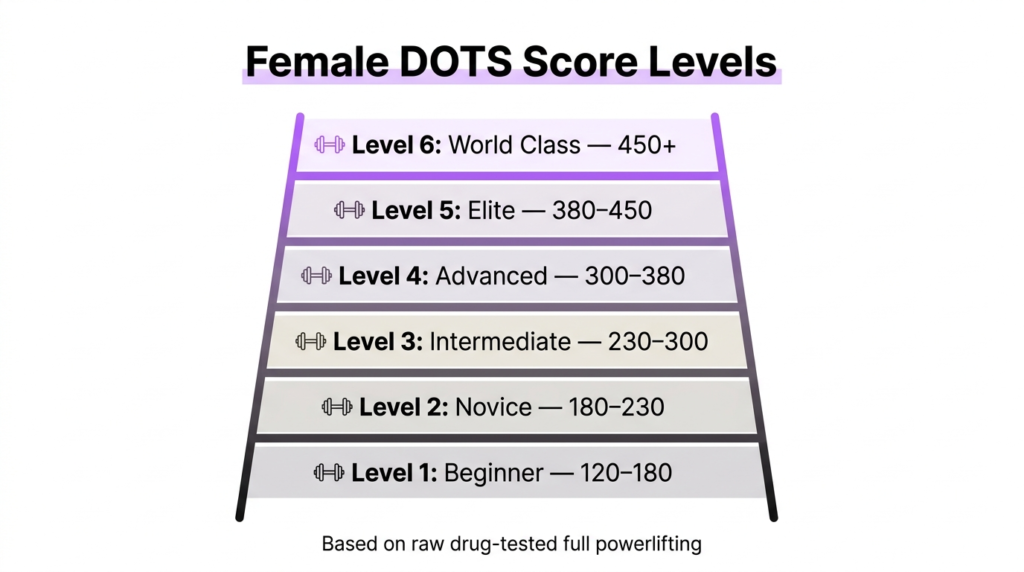
    infographic for Female DOTS Score Levels

    First competition targets for women

    A female lifter entering her first local meet typically scores between 200 and 300. Scoring above 280 at your first meet is a strong start. It puts you ahead of many beginner lifters. This is especially true in raw open divisions.

    What are good Wilks score benchmarks for female lifters?

    Wilks produces slightly different numbers than DOTS for the same lifter. Do not compare your Wilks score directly to your DOTS score.

    LevelWilks score
    Beginner100 – 175
    Novice175 – 250
    Intermediate250 – 325
    Advanced325 – 400
    Elite400 – 475
    World class475+

    How female Wilks scores compare historically

    The original Wilks formula had a known weakness in its female coefficients. The 1995 dataset used to build the formula underrepresented female lifters significantly. Wilks2 addressed this in 2020 with recalibrated constants. Female lifters in federations using Wilks2 get a fairer score than those still using the original formula.

    Does bodyweight affect female scores differently from male scores?

    The coefficient curve behaves differently for female lifters at extreme bodyweights. Very light female lifters under 47 kg fall into a smaller data range. Very heavy female lifters above 100 kg also fall into a smaller data range. In these ranges, the data behind the formulas is more limited.

    The DOTS formula is valid for female lifters between 40 kg and 150 kg. Outside that range, the coefficient is extrapolating beyond reliable data. Scores outside those bounds should not be used for official comparison purposes.

    Middle bodyweight female lifters

    Female lifters between 57 kg and 84 kg are in the most reliable range. This is where the data behind the formulas is strongest. Scores in this range are the most accurate. They give a better picture of true relative strength.

    How do female lifters use their score for progress tracking?

    The same way male lifters do. Check your score at the start and end of each training block. A rising score with stable bodyweight means real relative strength gains. A flat score during a bulk means the added weight is not producing proportional strength.

    Female lifters often see faster score gains in the first two years of training than male lifters at the same experience level. Strength adapts quickly early in a training career regardless of sex. Taking advantage of that window with consistent progressive overload moves the score quickly.

    The goal-setting approach built around 20 to 30 point increments works exactly the same for female lifters as it does for male lifters. The benchmark numbers differ. The strategy does not.

    Frequently asked questions

    Do women use the same DOTS formula as men?

    No. DOTS uses separate polynomial coefficients for female lifters. The scoring scale is the same for both sexes.

    Is a 300 DOTS score good for a female powerlifter?

    Yes. A 300 DOTS score is advanced for female lifters and competitive at regional meets.

    Can female and male DOTS scores be compared directly?

    Yes. Both formulas are designed to be fair for men and women. The same score means the same level of strength. This is true regardless of sex.

    Why is my Wilks score different from my DOTS score?

    The two formulas use different equations and datasets. They produce different numbers for the same lifter and are not directly comparable to each other.

    What bodyweight range gives the most accurate female DOTS score?

    Female lifters between 57 kg and 84 kg sit in the most reliable part of the DOTS coefficient curve. Scores in this range are the most statistically accurate.

    Your Score Is Your Standard

    Female powerlifters have the same access to meaningful relative strength data as male lifters. The formulas account for the difference. The scale stays the same.

    Calculate your current score using both systems. Use the powerlifting calculator to set your next target based on your result.



  • DOTS and Wilks Scores for Gym Lifters: Are They Worth Tracking?

    DOTS and Wilks Scores for Gym Lifters: Are They Worth Tracking?

    You train squat, bench, and deadlift seriously. You have no plans to compete.

    Most powerlifting scores are built for meet day. Federations use them to pick the best lifters and award trophies.

    But a score is just math. It does not care whether you competed or trained in your garage. If your squat, bench, and deadlift numbers go in, a valid relative strength score comes out.

    The real question is whether that number actually helps you train better.

    Do powerlifting scores matter outside of competition?

    Yes. Both scores give gym lifters something a raw total cannot. They give you a number that still makes sense when your body weight changes. Whether you are bulking, cutting, or maintaining, your score stays useful. It shows if your strength is really improving, not just your total.

    The problem with tracking totals alone

    A lifter who gains 8 kg during a bulk and adds 20 kg to their total looks like they are progressing. But if their score drops from 310 to 305, that tells a different story. It means their relative strength has gone down. The total went up because they got heavier, not because they got stronger relative to their size.

    What does a powerlifting score tell a gym lifter?

    It tells you how your strength compares to your bodyweight at any given point in time. That information is useful whether you compete or not.

    A gym lifter sitting at 320 DOTS is lifting at a level that would be competitive at a local powerlifting meet. A gym lifter at 280 is training seriously above average compared to most people in a commercial gym. Those reference points give your training real context.

    Comparing yourself to real standards

    Benchmark ranges show what each score means. They tell you where 280, 320, or 380 stands. You can see how you compare to recreational lifters, local competitors, and national-level athletes. That context turns a number into a meaningful performance indicator.

    Which score should a gym lifter track, DOTS or Wilks?

    Either works for personal benchmarking. DOTS is more accurate across a wider range of bodyweights based on modern data. Wilks is more widely recognized and has decades of historical use as a strength standard.

    If you have no federation affiliation, DOTS is the better default. It gives a fairer picture of relative strength across the full bodyweight spectrum. Run both through the strength calculator and pick whichever feels more useful for your tracking system.

    Does it matter which formula you pick?

    For personal benchmarking, no. What matters is consistency. Pick one formula and stick with it across every check-in. Switching between DOTS and Wilks breaks your tracking. The two formulas give different scores for the same lifter. So your past and current numbers would not match.

    How often should a gym lifter check their score?

    Every 8 to 12 weeks is a practical frequency for most gym lifters. That window aligns with a standard training block. Check your score at the start and end of each block. This gives you a clear before-and-after view. It also avoids noise from small weekly body weight changes.

    Checking more frequently than once per month adds very little useful information. Strength takes time to build. A score checked every two weeks can be misleading. It often reflects normal body weight changes. It does not always show real strength progress.

    What to record each time you check

    Write down your score with a few key details. Include your total, your body weight, and the date. These four numbers together give a clear picture. If your score goes up while your body weight stays the same, your strength is truly improving.

    Can gym lifters use their score to find weak points?

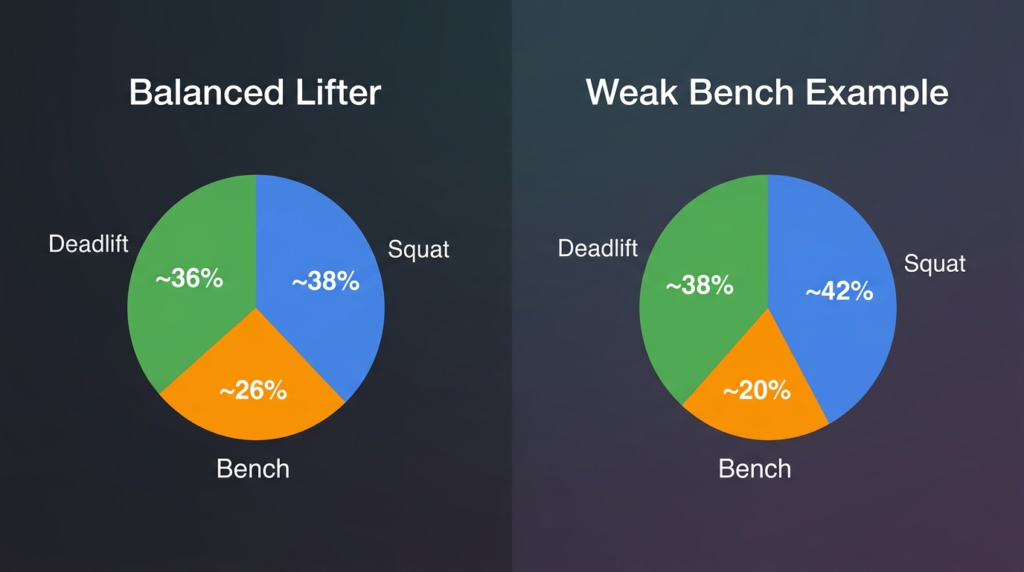
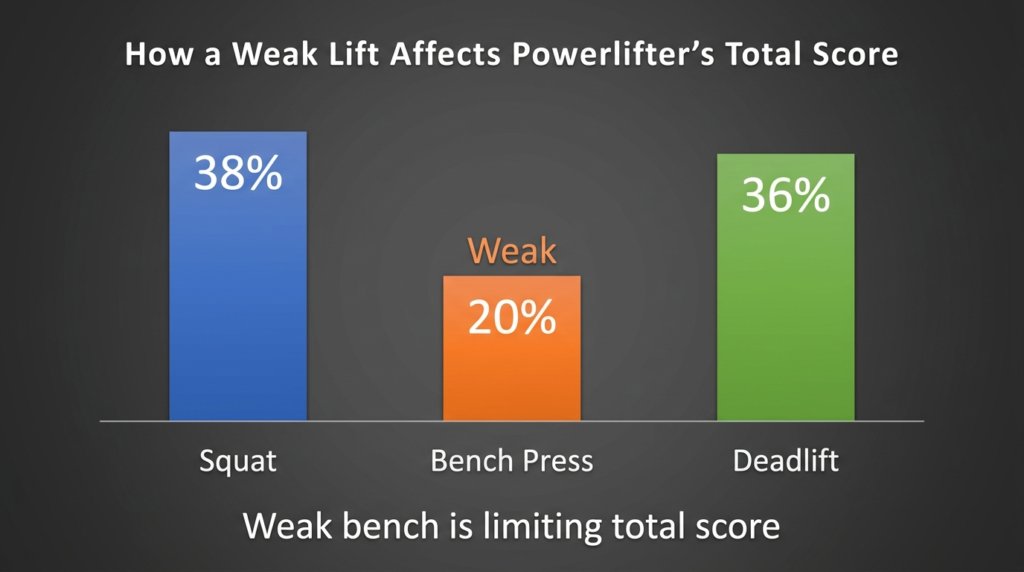
    Yes. Divide each of your three lifts by your total to see their percentage contribution. A balanced raw lifter has a typical split in their total. About 38% comes from the squat. Around 26% comes from the bench press. About 36% comes from the deadlift.

    If your bench sits at 20% of your total, it is the lift dragging your score down the most. Finding that imbalance helps you improve faster. Fixing your weak lift gives better results than training all lifts the same. The weak lift approach is the same strategy competitive lifters use to push their scores higher between meets.

    infograph for Can gym lifters use their score to find weak points

    Is a 300 score achievable for a dedicated gym lifter?

    Yes. A 300 DOTS or Wilks score is within reach for most lifters who train consistently for 18 to 24 months with a structured program. It requires discipline around programming and recovery but no special genetics or elite coaching.

    Crossing 300 puts you in territory where you could enter a local powerlifting meet and post a respectable result. Many gym lifters who hit that mark end up competing simply because their numbers are already there.

    What happens after 300

    The 300 to 370 range is where most serious gym lifters spend the majority of their training years. Moving through that range requires more than just adding volume. As progress slows, the small details matter more. Better technique becomes important. Smarter programming also makes a difference. Managing your body weight carefully starts to play a bigger role.

    Does tracking your score make training more motivating?

    As progress slows, the small details matter more. Better technique becomes important. Smarter programming also makes a difference. Managing your body weight carefully starts to play a bigger role.

    When your squat stalls but your bench and deadlift improve, your score still moves. That continuity keeps motivation higher than tracking individual lifts in isolation.

    Learning the history of these scoring systems helps you understand the numbers better. It shows what the score really represents. It also explains why it has been used for comparing lifters for so many years.

    Frequently asked questions

    Can gym lifters use DOTS and Wilks scores?

    Yes. Any lifter can train squats, benches, and deadlifts and calculate and track either score as a personal strength benchmark.

    Which is better for gym lifters, DOTS or the Wilks?

    DOTS is more accurate across most bodyweights based on modern data. Either works for personal tracking as long as you use the same formula consistently.

    Is a 300 DOTS score good for a gym lifter?

    Yes. A 300 DOTS score puts you well above average for recreational lifters and at the entry level of competitive powerlifting.

    How do I know if my relative strength is improving?

    Check your score at the start and end of each training block. A rising score with stable bodyweight means your relative strength is genuinely improving.

    Do I need to compete to get a meaningful score?

    No. Your score is just as valid and useful as a personal benchmark, whether you compete or not.

    Train With a Number That Means Something

    A raw total tells you how much you lifted. Your score tells you how strong you actually are for your size.

    For lifters who care about real progress, this difference matters a lot. Check your current score using the powerlifting tool on this page. Start tracking it from today.


  • How DOTS and Wilks Scores Are Used for Best Lifter Awards and Team Scoring

    How DOTS and Wilks Scores Are Used for Best Lifter Awards and Team Scoring

    Winning your weight class is straightforward. The lifter with the highest total wins.

    Best Lifter is different. It compares every lifter at the meet regardless of size. That is where DOTS and Wilks scores take over from raw totals completely.

    How is the Best Lifter award decided at a powerlifting meet?

    The Best Lifter award goes to the lifter with the highest score. This score is based on relative strength, not just total weight lifted. Every lifter who completes all three lifts gets a score. The lifter with the highest score wins. Body weight and total alone do not decide the winner.

    Why can raw totals not decide the Best Lifter

    A 120 kg lifter will almost always out-total a 60 kg lifter in absolute terms. Using raw totals to pick a best lifter would mean the heaviest weight class wins every time. Relative strength formulas like DOTS and Wilks exist specifically to prevent that outcome.

    Which formula decides the Best Lifter at each federation?

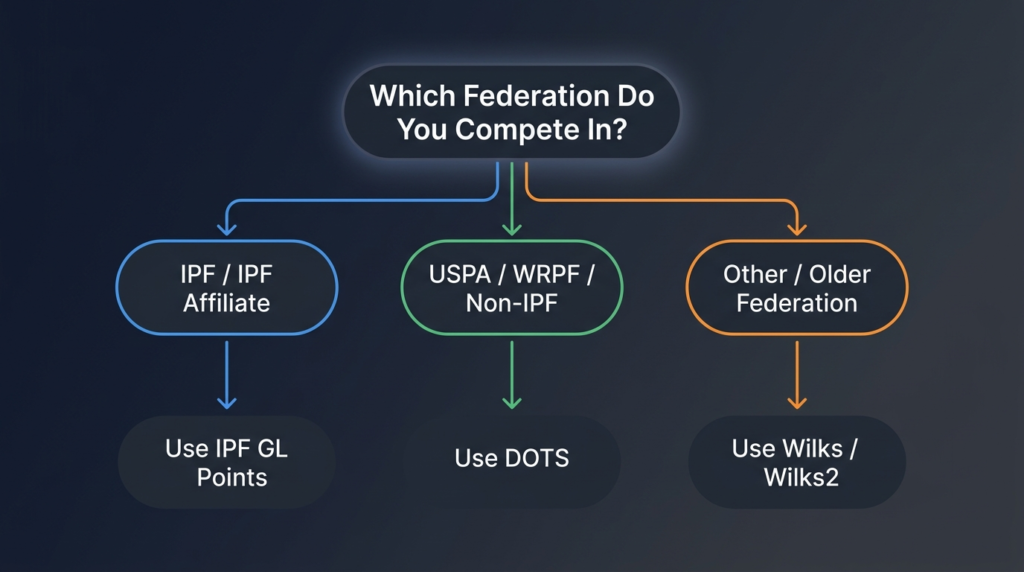
    The formula used depends entirely on the federation running the meet. USPA and WRPF use DOTS for open Best Lifter decisions. USAPL and all IPF affiliates use IPF GL Points, which you can calculate using our IPF GL calculator before stepping on the platform. World Powerlifting and Powerlifting Australia use Wilks or Wilks2.

    At a United States Powerlifting Association meet, the lifter with the highest DOTS score wins. This is across all open weight classes. That lifter gets the Best Lifter trophy. At a USAPL meet the same award goes to the lifter with the highest IPF GL points. The competition is identical in structure. Only the formula changes.

    Separate Best Lifter awards by division

    Most meets award Best Lifter separately across divisions. Open, junior, master, and sometimes sub-junior divisions each have their own best lifter. Male and female best lifters are also awarded separately. A meet may hand out four to eight Best Lifter awards depending on how many divisions competed.

    Understanding which federation uses which formula tells you what score matters. It shows you which number to focus on. This helps you aim for the Best Lifter award at your meet.

    How do age coefficients affect Best Lifter in the masters divisions?

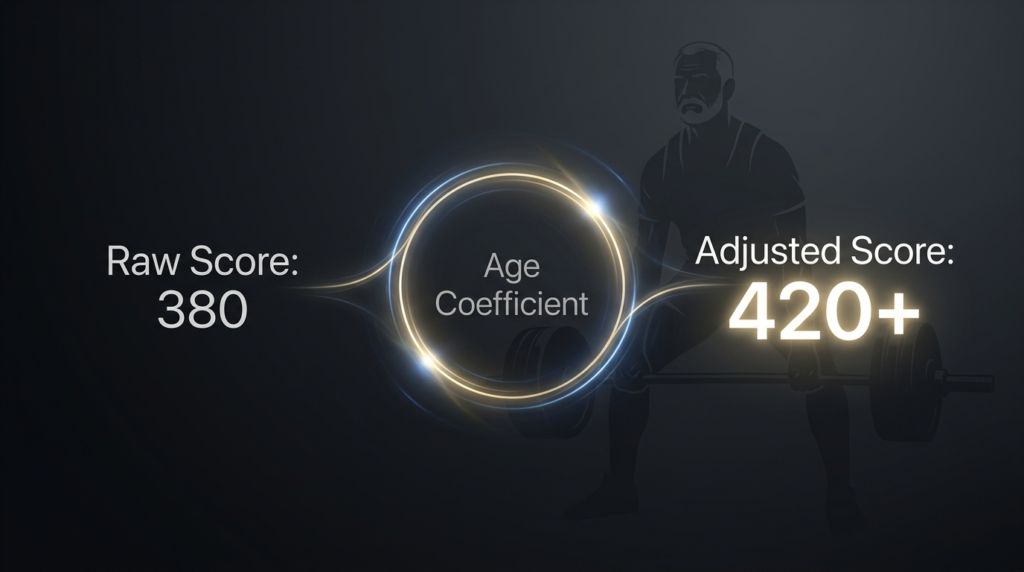
    Master’s divisions use an extra adjustment for age. This is added on top of the base DOTS or Wilks score. The most common system is the McCulloch coefficient. It applies a multiplier based on your age. Older lifters get a higher multiplier. This helps account for the natural drop in strength over time.

    A 55-year-old lifter might have a DOTS score of 380. After the McCulloch adjustment, that score can rise to 420 or more. The exact number depends on age. In the master’s categories, this adjusted score is what matters. The raw DOTS or Wilks score alone is not used to decide the winner.

    infograph for How do age coefficients affect Best Lifter in masters divisions

    Why is the master’s scoring separate from the open

    Comparing a 55-year-old lifter to a 25-year-old using raw scores is not fair. The older lifter would be at a disadvantage. That is why an age adjustment is used in masters divisions. It creates a fair comparison within the same age group. At the same time, it keeps the same basic strength scoring system.

    The full explanation of age adjustments is covered in the master’s scoring article. It shows how the McCulloch coefficient is applied in competition.

    What is team scoring in powerlifting?

    Team scoring adds up the scores of lifters from the same team. Each lifter’s score contributes to a combined team total. That total is used to rank teams at the meet. Teams compete against other teams at the same meet. The team with the highest combined score wins.

    Different meets use different team scoring rules. Some add the top three DOTS or Wilks scores from a team. Others use the top five. Some weigh the scores equally. Some systems add extra adjustments. They use multipliers based on how many lifters a team has in each weight class. This can change the final team score.

    USPA All Stars and DOTS qualifying

    The USPA All Stars is an invite-only event. It uses DOTS scores to decide who qualifies. Male lifters usually need a score of 500 or more. Female lifters need around 475 or more. These scores must come from a drug-tested meet. The result can come from any approved competition. It does not have to be a United States Powerlifting Association event.

    This means the DOTS score is not just for tracking. It is also required to qualify for the event. Lifters aiming for All Stars need to track their score at every meet. Checking your current numbers helps you see how close you are. It also helps you plan how long it will take to reach the required score.

    Can you target a Best Lifter award strategically?

    Yes. Attempt selection matters a lot. A lifter who starts safe and makes all nine lifts can get a better score. A lifter who misses big attempts may end up with a lower total. Hitting lifts consistently often leads to a higher final score.

    Your best total is your best score. Consistent attempts beat failed heroics whenever “best lifter” is the goal.

    Bodyweight management for Best Lifter

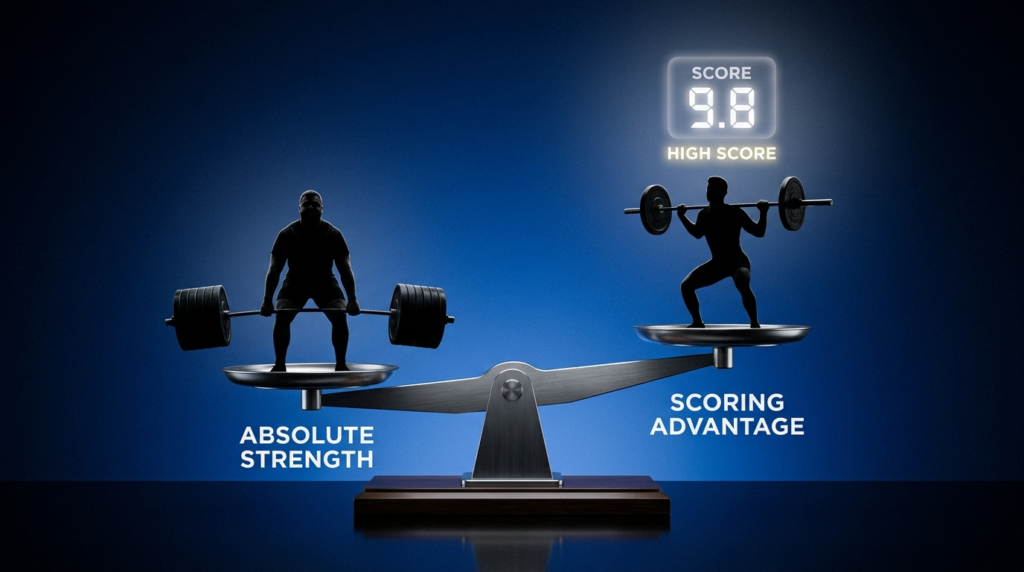
    Lighter lifters have an advantage in the scoring system. A 66 kg lifter with a strong total can outscore a 93 kg lifter. This can happen even if the heavier lifter lifts more weight overall. That is why some lifters choose lighter weight classes. It can help them compete for Best Lifter.

    infograph for Balance_scale_showing

    The weight cut strategy article explains this in detail. It shows when cutting weight actually helps your score. It also explains when the strength loss is not worth it.

    Does your gym total count for Best Lifter?

    No. Best Lifter awards at sanctioned meets are based on competition totals only. Gym PRs, training maxes, and estimated totals from training cycles do not count. You need a valid competition total with all three lifts completed to receive a Best Lifter score.

    Some federations have extra rules for the best lifter. You may need to compete in the open division to qualify for the overall award. Masters and junior lifters can still win in their own divisions. But they may not be eligible for the overall Best Lifter, depending on the rules.

    Frequently asked questions

    How is the best lifter decided in powerlifting?

    The lifter with the highest relative strength score wins. USPA uses DOTS. USAPL uses IPF GL Points. World Powerlifting uses Wilks.

    Can a lighter lifter win Best Lifter over a heavier one?

    Yes. Relative strength formulas adjust for bodyweight. A 66 kg lifter with a strong total regularly outscores heavier lifters at well-run meets.

    What DOTS score do I need to win Best Lifter?

    It depends on the competition. Local meets may be decided by scores of around 380 to 420. National-level Best Lifter winners often score above 480.

    Do master lifters compete for the overall best lifter?

    It depends on the federation. Some include masters in the overall Best Lifter pool. Others award Best Lifter separately by division.

    What is the USPA All Stars qualifying DOTS score?

    Male lifters need 500 DOTS from a drug-tested meet. Female lifters need 475 DOTS to qualify at the top registration tier.

    The Score Behind the Trophy

    Best Lifter is the most meaningful award at any powerlifting meet. It rewards relative strength across all sizes and weight classes.

    Your DOTS or Wilks score is the number that decides it. Check where yours stands right now using the powerlifting calculator on this page.

  • How Cutting Weight Changes Your DOTS and Wilks Score in Powerlifting

    How Cutting Weight Changes Your DOTS and Wilks Score in Powerlifting

    Every competitive lifter asks the same question at some point. Should I cut to a lower weight class?

    The answer depends on one thing. How much does dropping bodyweight actually move your score if your total stays the same?

    Does cutting weight improve your DOTS or Wilks score?

    It can. Both formulas apply a higher coefficient to lighter bodyweights. Lower body weight with the same total produces a higher score. But the math only works in your favor if your total does not drop during the cut.

    The quick answer

    A weight cut raises your score only if your total remains the same. Lose 3 kg of bodyweight and keep the same squat, bench press, and deadlift, and your score goes up. Lose 3 kg and lose 15 kg from your total, and your score drops.

    How much does bodyweight affect the coefficient?

    The coefficient change per kilogram varies depending on where you sit on the bodyweight curve. The relationship is not linear. Dropping from 84 kg to 83 kg produces a smaller coefficient shift than dropping from 60 kg to 59 kg.

    For most lifters in middle weight classes, the coefficient gain from a 2 to 3 kg cut is modest. A male lifter dropping from 84 kg to 81 kg with the same total gains roughly 4 to 7 DOTS points. That is meaningful at the competition level but not dramatic for personal tracking.

    Where cuts have the biggest scoring impact

    Lifters who are already close to the lower end of their weight class get the most benefit from cutting. Their score usually increases more when they lose weight. A 59 kg lifter dropping to 57 kg gains more per kilogram lost than a 93 kg lifter dropping to 90 kg. This is a direct result of how the polynomial curves in both DOTS and Wilks formulas are shaped at lower bodyweights.

    What happens to your score if your total drops during a cut?

    Your score falls. The score boost from weighing less is usually small. It does not make up for a big drop in your total. A 10 kg loss in total wipes out the coefficient benefit of a 2 to 3 kg bodyweight cut in most weight class ranges.

    Hard cuts in the final days before a meet are the most dangerous for your total. Severe water restriction and sodium manipulation affect muscle contractility and neural drive. Lifters who cut more than 4 kg in the last 48 hours often lose strength. This can hurt their performance on the platform.

    The break-even point

    For a cut to be worth it, your total needs to stay in a certain range. This depends on your body weight and the formula your federation uses. You can check this before cutting. Run your numbers at both body weights in a calculator. This shows the total you need to keep, so the cut makes sense.

    Does DOTS respond differently to weight cuts than Wilks?

    Yes, slightly. The two formulas use different curves. So, the score change for each kilogram is not the same. For most lifters in middleweight classes, the difference is small. At extreme bodyweights the gap between how DOTS and Wilks respond to the same cut can be more noticeable.

    DOTS tends to produce a more gradual coefficient change across the bodyweight curve. Wilks has steeper shifts in some ranges, particularly at lighter bodyweights. A lifter cutting from 60 kg to 59 kg may see a larger Wilks gain than DOTS gain from that same cut.

    Tracking both scores during a cut

    Lifters using Wilks in competition but tracking DOTS should check both scores. Do this at your planned body weight after the cut. Both formulas react differently to the same body weight and total. So your score may change in different ways under each system. The multi-system comparison shows how the cut affects your score in each formula. It helps you decide if the cut is worth it.

    When is a weight cut actually worth it?

    A cut makes strategic sense in three situations. First, when you are sitting significantly above the weight class limit with room to cut without affecting performance. Second, when the competition in the lower weight class is weaker than in your current class. Third, when your total is strong enough that even a slight drop still produces a higher score at the lighter bodyweight.

    Most recreational lifters and first-year competitors have no reason to cut weight for scoring purposes. Building total strength produces far better score gains than any realistic weight cut at early training levels.

    The long game vs the short game

    Cutting weight is a short-term scoring tactic. Building a bigger total is a long-term scoring strategy. Lifters who focus on cutting weight early often stall sooner. They spend less time building strength. Lifters who focus on getting stronger first usually keep improving longer.

    The goal-setting framework around score targets helps put this in perspective. A 20-point score gain from stronger lifts lasts. A 5-point gain from a weight cut disappears the moment you rehydrate.

    What about natural bodyweight fluctuations?

    Day-to-day bodyweight swings of 1 to 2 kg are normal and expected. Your body weight can change day to day. These small changes can slightly affect your score. That is why random checks can be misleading. Checking your score at the same time, on the same day, and under the same conditions gives more reliable results.

    For personal tracking, use your normal training body weight. Avoid using a cut or dehydrated competition weight. Your body weight during a cut is temporary and does not reflect your real condition. Using your stable weight gives a more accurate score. It shows your true strength based on how you normally train.

    Frequently asked questions

    Does cutting weight always improve my powerlifting score?

    No. A cut only helps if your total stays the same or rises. A drop in total after a cut almost always outweighs the coefficient gain from lower bodyweight.

    How many points does a 3 kg cut add to my DOTS score?

    For most lifters in middle weight classes, a 3 kg cut with the same total adds roughly 4 to 8 DOTS points, depending on your starting bodyweight.

    Is cutting weight better for Wilks or DOTS?

    The response differs slightly. Wilks tends to produce steeper coefficient shifts at lighter bodyweights. DOTS changes more gradually across the full bodyweight curve.

    Should beginners cut weight to improve their score?

    No. Beginners gain far more score points from building total strength than from any weight cut. Focus on the total first.

    How do I know if a cut is worth it before my meet?

    Calculate your score at your current bodyweight and again at your target cut weight using the same total. If the gain is less than 5 points, the cut is probably not worth the performance risk.

    Cut Smart

    A weight cut is a tool, not a strategy. Used at the right time with enough total strength behind it, it gives you a small but real scoring edge.

    Used too early or too aggressively, it costs you more on the platform than it gains on the scoreboard.


  • How to Set Realistic Powerlifting Goals Using Your DOTS and Wilks Score

    How to Set Realistic Powerlifting Goals Using Your DOTS and Wilks Score

    Most lifters set goals around their total. They pick a number and chase it.

    The problem is that a total means different things at different bodyweights. A 500 kg total at 74 kg is elite. That same total of 120 kg is intermediate. Your DOTS or Wilks score removes that ambiguity completely.

    Can your score help you set better training goals?

    Yes. A bodyweight-adjusted score gives you a steady target. It stays useful even when your body weight changes. Focusing on a score instead of just your total keeps your goals consistent. It helps during bulking, cutting, and moving between weight classes.

    Why raw totals make poor long-term targets

    A lifter who gains 10 kg during a bulk may lift more weight. But their score can stay the same or even drop. That bulk produced size, but not relative strength. Tracking your score alongside your total exposes that difference immediately.

    How do you turn your score into a goal?

    Start with where you are. Run your current squat, bench press, and deadlift through the calculator and record your score. That number is your baseline. Everything else builds from there.

    Next, look at the benchmark ranges for your level. An intermediate lifter sitting at 320 DOTS has a clear next target of 350. That 30-point gap is achievable in one solid training cycle. You do not need big changes in body weight or your program.

    Set targets in 20 to 30 point increments

    Jumping from 320 to 420 in one cycle is not realistic. Jumping from 320 to 345 is. Small, stacked targets build momentum and give you something meaningful to hit at the end of every training block.

    infograph for A horizontal or upward step progression layout

    Lifters who understand score ranges make better goals. They can choose targets that are challenging but still realistic for their level.

    What score should you aim for as a beginner?

    A beginner lifter with 6 to 12 months of consistent training should target a score between 220 and 280. Crossing 280 in your first year of serious training puts you ahead of most casual gym lifters. Reaching 300 is a meaningful milestone that shows your programming and recovery are working.

    First competition targets

    If your goal is to compete at a local meet and be competitive, a score of 300 to 330 is a reasonable entry point for most raw open divisions. You will not win a regional meet at that level, but you will not embarrass yourself either. Most first-time competitors score between 280 and 360, depending on bodyweight and division.

    How do intermediate lifters use their score for goal setting?

    Intermediate lifters in the 300 to 400 range can benefit the most from score-based goals. This is the stage where training choices start to matter more. Things like programming, weight class, and which lift to focus on make a big difference.

    At this level, gaining 20 points usually means fixing a weak area. You might need to train your bench more often. Improving your squat depth can also help you lift heavier. Managing your body weight better during your training cycle is another key factor.

    Identifying the lift holding you back

    Divide your three lifts by your total to find their percentage contribution. If your bench press is consistently below 25% of your total, it is the lift costing you the most points. Focusing your next training block on that lift produces faster score gains than spreading effort evenly.

    The practical strategies for improving your score go into this in more detail. They explain how to fix weak lifts with clear training changes.

    How do advanced lifters set score targets?

    Above 400, the score gains get harder and slower. An advanced lifter moving from 420 to 440 may need two full training cycles, each 16 weeks long. At this level, small improvements matter a lot. A better technique can make a difference. A good peaking plan also helps. Choosing the right attempts is just as important as getting stronger.

    infograph for How do advanced lifters set score targets

    Advanced lifters should track their score in more than one system. This gives a clearer picture of their strength. For example, a lifter using DOTS can also track Wilks. Running both after each training block shows if progress is consistent. Or if the improvement only shows in one system.

    Using historical scores as targets

    One of the best ways to set goals at an advanced level is to use your own best score. If you once hit 435 DOTS but are now at 420, that gap becomes your target. Getting back to your previous best is a strong short-term goal. After that, you can aim to push even higher.

    Learning how these scoring systems were built can help advanced lifters. It explains why scores change at different body weights. It also shows why some training phases lead to bigger score increases than others.

    Should you set different targets for DOTS and Wilks?

    Yes. The two formulas produce different numbers for the same lifter. Set separate targets for each system based on the benchmark ranges specific to that formula.

    A lifter targeting 380 DOTS is not automatically targeting 380 Wilks. Most lifters score slightly higher on Wilks than DOTS at the same bodyweight and total. Check both numbers separately and set independent goals for each based on which federation you compete in.

    Frequently asked questions

    What is a realistic score goal for a beginner?

    Crossing 280 in your first year is strong progress. Reaching 300 within two years shows your training is working effectively.

    How many points can I gain in one training cycle?

    Most intermediate lifters gain 15 to 25 points per 12 to 16 week cycle with focused programming and controlled bodyweight. Most intermediate lifters gain 15 to 25 points per 12 to 16 week cycle with focused programming and controlled bodyweight.

    Should I set DOTS and Wilks goals separately?

    Yes. They use different formulas and produce different numbers. Set independent targets for each based on your federation and benchmark ranges.

    Is chasing a score better than chasing a total?

    For long-term development, yes. A score-based goal stays meaningful across bodyweight changes. A total-based goal loses context when your weight shifts.

    How do I know if my goal is realistic?

    If your target is 20 to 30 points above your current score, it is realistic for one training cycle. Anything above 50 points is a multi-cycle goal.

    One Number, Clear Direction

    Your score turns three separate lift numbers into one honest measure of where you stand. Set your next target, build your block around your weakest lift, and check your progress at the end.

    The powerlifting calculator on this page gives you your current number in seconds. Start there.

  • How to Improve Your DOTS and Wilks Score in Powerlifting

    How to Improve Your DOTS and Wilks Score in Powerlifting

    Your score is not moving. Your total is going up, but the number stays flat.

    That happens more than most lifters expect. Knowing exactly what drives your score is the fastest way to fix it.

    What actually moves your DOTS or Wilks score?

    Two things control your score: your powerlifting total and your bodyweight. Your total is the sum of your squat, bench press, and deadlift. Your body weight determines the coefficient applied to that total.

    Increase your total without gaining bodyweight, and your score goes up. Gain bodyweight without increasing your total, and your score drops. Both variables matter every single training block.

    The simple math behind it

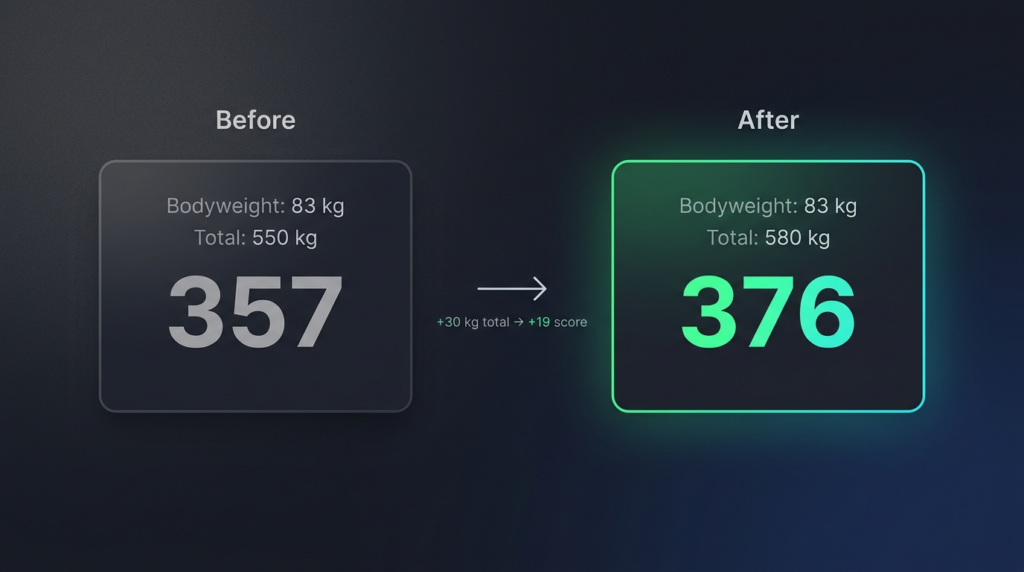
    A male lifter at 83 kg with a 550 kg total scores around 357 DOTS. Add 30 kg to that total while staying at 83 kg, and the score jumps to around 376. That 19-point gain came purely from a stronger total with no bodyweight change.

    infograph for The simple math behind it

    Which lift contributes most to your score?

    All three lifts contribute equally in terms of formula mechanics. Your squat, bench press, and deadlift add directly to your total. A kilogram added to any lift is worth exactly the same as a kilogram added to any other.

    In practice, most lifters have one lift that lags significantly behind the other two. That weak lift is where your biggest score gains are hiding.

    Find your weakest lift first

    Compare your three lifts to your total. A balanced raw lifter typically squats around 38%, benches around 26%, and deadlifts around 36% of their total. If your bench is at 20% of your total, it is pulling your score down more than your training split reflects.

    infograph for Two side-by-side visual comparisons

    When lifters compare their numbers to level benchmarks, they understand their performance better. They can see how each lift compares to competitive standards. This makes it easy to spot which lift is lagging behind.

    Does losing bodyweight improve your score?

    Sometimes. The relationship between bodyweight and your coefficient is not linear. Dropping from 84 kg to 83 kg to move into a lower weight class shifts your coefficient slightly upward. But if that cuts your strength in any of your three lifts, your total drops, and your score follows.

    A weight cut only helps your score if your total stays the same or goes up after the cut. Most lifters underestimate how much a hard cut affects their squat and deadlift on meet day.

    When a weight cut makes sense

    Cutting weight can help your score in some cases. It works best when you are above your weight class limit. And when you can cut weight without hurting your performance. A 2 to 3 kg water cut the day before weigh-in is manageable for most experienced lifters. Anything beyond that starts eating into total potential.

    The federation breakdown also shows how weight class rules work. It explains how different organizations apply these rules with their scoring systems. This affects when and how lifters cut weight before weigh-ins.

    How does training frequency affect your score?

    Higher training frequency on weak lifts accelerates total growth. A lifter benching once per week who moves to three sessions per week typically sees faster bench progress. That improvement feeds directly into a higher total and a better score.

    Frequency alone is not enough. The quality of each session, progressive overload, and recovery all determine how fast your total grows. But if one lift is clearly behind, adding volume to it is the most direct route to a higher score.

    Peaking for competition

    Matter in, pick your score at a meet should be higher than your score in training. A proper peaking cycle of 4 to 6 weeks before competition reduces fatigue and lets your true strength express itself on the platform. Most lifters leave 5 to 10% of their total on the table by not peaking properly.

    Should you focus on DOTS or Wilks when training?

    Neither. Train to increase your total and manage your bodyweight. The formula applied to those two numbers is decided by your federation, not your training program.

    Lifters who focus too much on which formula gives a higher score are wasting energy. You should channel that energy into your gym training. A stronger total improves your score under every system. Comparing all major scoring formulas shows one thing clearly. No training method is built for just one formula.

    How often should you recalculate your score?

    Once per training block is enough. A standard block runs 8 to 16 weeks. Check your score at the start and end of each block. It helps you see what really improved. Whether your strength improved relative to your body weight or just your total went up.

    Checking more often than that introduces noise. Week-to-week fluctuations in bodyweight alone can shift your score by 5 to 10 points without any real change in strength.

    Run your current numbers through the calculator at the end of each block and record the result alongside your total and bodyweight. Three data points tell you more than any single score.

    Frequently asked questions

    What is the fastest way to improve my DOTS score?

    Increase your total while keeping your bodyweight stable. Adding strength to your weakest lift produces the fastest score gains.

    Does losing weight always improve my score?

    No. A weight cut only helps if your total stays the same or rises after the cut. Losing strength during a cut lowers your score.

    How long does it take to raise my score by 20 points?

    For most intermediate lifters, a 20-point gain takes one to two serious training cycles of 12 to 16 weeks each.

    Should I focus on one lift to improve my score?

    Focus on your weakest lift first. One lagging lift holds back your total more than evenly distributed weakness across all three.

    Does my score improve automatically as I get stronger?

    Only if your body weight stays controlled. Getting stronger while gaining significant bodyweight can keep your score flat even as your total climbs.

    Keep Pushing

    Your score changes when your total moves. That is the whole game.

    Matter in Pick your weakest lift. Train it more with focused work. Then check your numbers again after your next training block using the scoring tool on the same website.

  • Are DOTS and Wilks Scores Accurate? What the Data Actually Shows

    Are DOTS and Wilks Scores Accurate? What the Data Actually Shows

    Your score looks clean and objective. But is the formula behind it actually fair?

    Every powerlifting scoring system has limitations. Some are small. Some affect entire weight classes. Knowing where each formula falls short helps you interpret your numbers honestly.

    How accurate are DOTS and Wilks scores?

    Both DOTS and Wilks produce reasonable relative strength estimates for most lifters. Neither is perfectly accurate across every bodyweight, sex, and division combination. The differences are most pronounced at extreme bodyweights and in equipped divisions.

    The quick answer

    DOTS is more consistent across all body weights than the original Wilks. Neither formula accounts for height, limb length, or body composition. Both are mathematical approximations, not perfect measures of true strength.

    What did the 2020 IPF study reveal?

    In March 2020, the International Powerlifting Federation reviewed several scoring formulas. They tested two main things. How fair was each formula across different weight classes? And how well it ranked lifters by real strength.

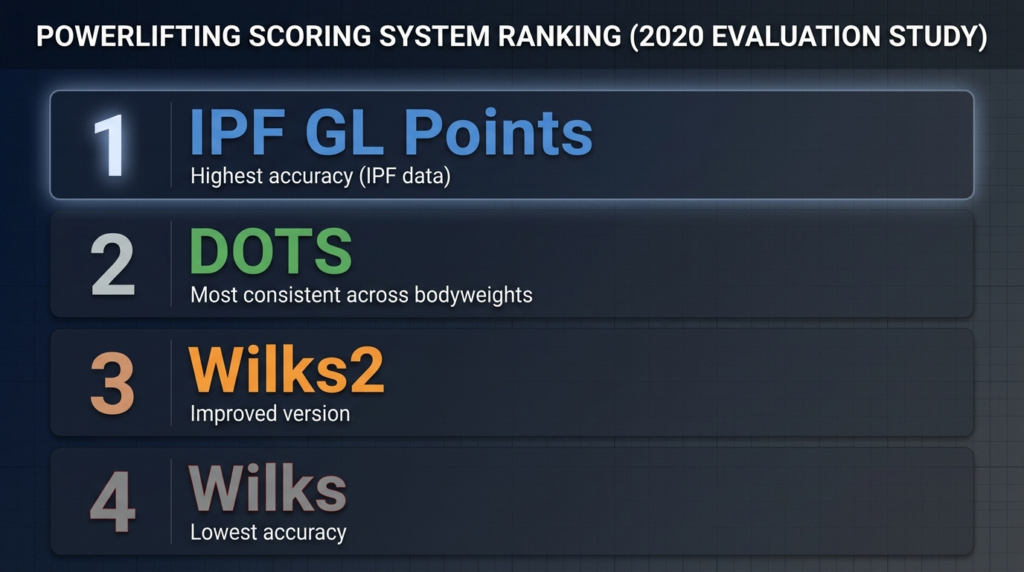
    The results were clear. IPF GL Points ranked first. DOTS came second. Wilks2 came third. Lifters in IPF affiliates can check their own Goodlift score to see where they stand under the top-ranked formula. The original Wilks formula showed the lowest performance in several areas.

    infograph for What did the 2020 IPF study reveal

    What the study measured

    The evaluation used the coefficient of variation to test scoring consistency. Lower variation means the formula treats equivalent efforts more equally across weight classes. DOTS showed lower variation than the original Wilks in nearly every category tested. That gap was largest at the lightest and heaviest bodyweights.

    Where does the original Wilks formula fall short?

    The original Wilks formula was built on 1995 competition data. That dataset underrepresented female lifters and lifters at extreme bodyweights. The resulting polynomial curve produced a systematic scoring advantage for middleweight male lifters.

    A 93 kg male lifter could score higher than a 59 kg lifter. This can happen even when both have the same level of effort. The reason is the way the formula is set up. It favors certain body weights. So, the difference comes from the formula, not actual strength.

    The bias at extreme bodyweights

    The original Wilks formula had some clear issues. It gave too much credit to very heavy male lifters in some cases. It also gave too little credit to very light lifters in others. Female super-heavyweight lifters also experienced the effects. Many people noticed these problems for years. Coaches and analysts pointed them out during the 2000s and 2010s. This is why the International Powerlifting Federation later decided to review the formula.

    Understanding why federations moved away from Wilks helps give context. It shows why these accuracy issues were serious enough to change the sport.

    Is DOTS more accurate than Wilks?

    Yes, in most cases. DOTS was created to fix the problems in the Wilks formula. It uses more recent and larger data. This makes the scoring more balanced across different body weights. For example, a 59 kg lifter and a 120 kg lifter with the same level of effort will get more similar scores under DOTS. Under the original Wilks, the difference would be bigger.

    The improvement is most significant at body weights below 60 kg and above 110 kg. For lifters in the 74 kg to 93 kg range, the difference between DOTS and Wilks scores is smaller but still present.

    Where DOTS still has limits

    DOTS performs well within its validated bodyweight range. For male lifters, that range is 40 kg to 210 kg. For female lifters, it is 40 kg to 150 kg. Outside those bounds, the formula is extrapolating beyond its dataset. Scores produced outside those ranges should not be used for official comparison.

    What do neither DOTS nor Wilks account for?

    Both formulas ignore several physical factors that genuinely affect lifting performance.

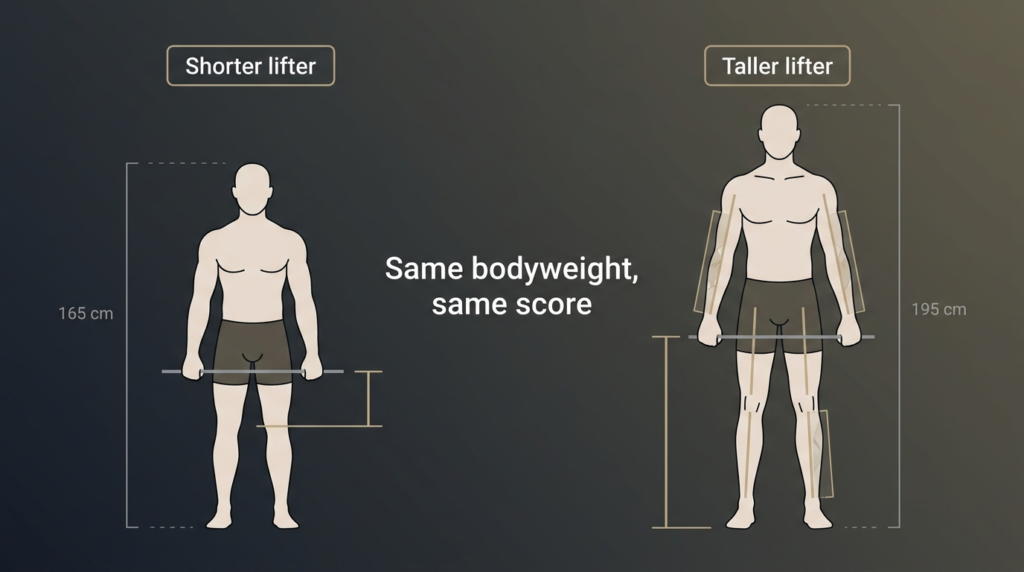
    Height is the most discussed limitation. Two lifters at 83 kg with heights of 165 cm and 195 cm have very different mechanical advantages on the squat and deadlift. The taller lifter has a longer range of motion on every lift. Neither DOTS nor Wilks adjusts for this at all.

    Limb length also plays a role. Shorter arms can help in the bench press. Longer arms can help in the deadlift. These advantages are not included in current scoring formulas. Body composition is also not considered. For example, two lifters at 83 kg can be very different. One may have 15% body fat, while another has 25%. They do not have the same amount of muscle, but the formula treats them the same.

    image for Are DOTS and Wilks Scores Accurate What the Data Actually Shows

    Why these factors are not included

    Adding things like height, limb length, or body composition would make scoring more complex. It would require measuring these factors at every meet. That creates problems with accuracy and consistency. Because of this, no federation has added them to scoring formulas. So, the formulas only use body weight and total by design.

    A full comparison of all three scoring systems helps you see the differences. It shows how each formula handles these tradeoffs in its own way.

    Does accuracy matter for gym lifters?

    For lifters who track their score as a personal benchmark, small formula biases matter very little. The number moves in the right direction when your relative strength improves. That is all most non-competitive lifters need from it.

    Formula accuracy matters most in competition. Sometimes, the gap between first and second place is tiny. At that level, even a tiny difference in scoring can decide the winner. That is why the formula a federation uses can change who wins. Tracking your score over time is more important than a single result. Using the same calculator regularly shows your real progress. The trend matters more than which formula you use.

    Use the trend, not the number

    A score of 387 means very little on its own. A score that moved from 340 to 387 over 12 months of training means a great deal. The accuracy of the formula matters less than the consistency of how you measure progress. Understanding score ranges helps you see where you stand. It puts your progress into context. It also shows if you are on track compared to other lifters.

    Frequently asked questions

    Is DOTS more accurate than Wilks?

    Yes. DOTS was built on more modern data and produces fairer scores across extreme bodyweights. The original Wilks formula has documented biases at very light and very heavy bodyweights.

    Does DOTS account for height?

    No. DOTS adjusts for bodyweight only. Height, limb length, and body composition are not part of the formula.

    Why did Wilks score poorly in the 2020 study?

    The original Wilks formula used limited 1995 data. It lacked enough very light, very heavy, and female lifters. Because of this, the results were not balanced. Newer formulas use larger and more recent data, so they give more accurate results.

    Is IPF GL more accurate than DOTS?

    Within IPF competition data, yes. IPF GL ranked first in the 2020 evaluation. Outside IPF data, DOTS performs more consistently across all federation contexts.

    Does formula accuracy affect my training?

    No. The training goal is always the same: increase your total and manage your bodyweight. A stronger total improves your score under every formula.

    The Real Takeaway

    No scoring formula is perfect. DOTS is the most balanced option available today for raw lifting across all bodyweights. Wilks is still meaningful but carries known limitations from its 1995 origins.

    Use the formula your federation requires. Track your trend over time. The direction of your score matters far more than its exact number.


  • Which Powerlifting Federations Use DOTS, Wilks, or IPF GL?

    Which Powerlifting Federations Use DOTS, Wilks, or IPF GL?

    You trained hard. You have a solid total. But which score actually matters at your meet?

    It depends on your federation. Different organizations use different formulas. If you use the wrong calculator, the score you get will not mean anything in competition.

    Which scoring system does each federation use?

    Powerlifting is split across three main scoring systems today, which are DOTS, Wilks (Wilks2), and IPF GL points. No single formula is universal. Your federation decides which score counts. It affects the best lifter awards, rankings, and qualifying standards.

    The three-way split explained

    The IPF and all its national affiliates use IPF GL Points exclusively. Most major non-IPF federations use DOTS. A smaller group still uses Wilks or Wilks2. Understanding where each federation sits helps you track the right number from day one.

    Which federations use DOTS?

    DOTS started becoming popular around 2020. The United States Powerlifting Association was one of the first big federations to use it. They use it for the best lifter awards and rankings. The World Raw Powerlifting Federation also adopted it soon after.

    Other federations, like the Global Powerlifting Committee, use DOTS as well. Many smaller national federations follow the same approach. Today, DOTS is the most common scoring system outside the International Powerlifting Federation.

    image for Which Powerlifting Federations Use DOTS, Wilks, or IPF GL

    DOTS for best lifter awards

    At USPA meets, the best lifter award goes to the open division lifter with the highest DOTS score across all weight classes. The USPA All Stars qualifying system also uses DOTS thresholds directly. Male lifters need 500 or above. Female lifters need 475 or above to qualify at the top tier.

    Anyone competing in a DOTS federation can check their score before the meet. You can use a powerlifting calculator on this page to see where you stand.

    Which federations use IPF GL Points?

    World Powerlifting and Powerlifting Australia are the main federations that still use Wilks or Wilks2. Powerlifting Australia uses Wilks2, which is the updated version released in 2020. It was made to fix some issues in the original formula.

    World Powerlifting and some other federations still use either the original Wilks or Wilks2, depending on their rules. There are also smaller and older federations that continue to use the original Wilks. Most of these organizations have not updated their scoring systems yet, so they still follow the older method.

    IPF GL and Powerlifting America

    Powerlifting America uses IPF GL Points as its official scoring system. USAPL lifters can check their score using the Goodlift points calculator before their next meet. This means all competitions under this federation use the same formula for scoring. At the international level, the International Powerlifting Federation also uses IPF GL Points. So, if you compete at the IPF World Championships or any IPF event, your ranking is based only on IPF GL points. No other scoring system is used in these competitions.

    Which federations still use Wilks?

    World Powerlifting and Powerlifting Australia are the main federations that still use Wilks or Wilks2. Powerlifting Australia uses Wilks2. This is the updated version from 2020.

    Some smaller national and older regional federations still use the original Wilks. These are usually groups that have not updated their rules since newer scoring systems were introduced.

    Is Wilks still relevant?

    Yes. For lifters in World Powerlifting or Powerlifting Australia, Wilks is the score that matters in competition. It is the only score used at official meets. Understanding how the formula works also helps. It makes it easier to read your score and know what it really means.

    What about smaller or regional federations?

    Smaller federations vary widely. Some follow the IPF model and use IPF GL. Others adopted DOTS when larger non-IPF bodies made the switch. A handful still use the original Wilks formula from 1995.

    Always check your federation’s rules before you meet. You can also ask the meet director to be sure. Sometimes, a local meet may use a different scoring system than the main federation.

    Push-pull and bench-only meets

    Most scoring formulas, like DOTS and Wilks, are made for full powerlifting. That means all three lifts: squat, bench press, and deadlift. Push-pull meets (bench + deadlift), and bench-only meets use adjusted versions of these formulas. Because of this, the scores are different. A bench-only score is not the same as a full power score. That is why you should not compare them directly.

    Understanding how these formulas work helps you see the difference. Bench-only scores are on a completely different scale than full power results.

    How do you know which score to track?

    Check your federation’s official website or rulebook. Look for the “best lifter” or scoring section. It will clearly tell you which formula is used. It may also mention extra adjustments, like age-based systems such as McCulloch. This matters because different meets can use different scoring methods, and the correct one is what counts in competition.

    Lifters who compete in different federations often track two or three scores. This helps them see their strength under each system. You can enter your numbers once in a calculator and get DOTS, Wilks, and other scores together. This makes it easy to compare your results side by side.

    image for Which Powerlifting Federations Use DOTS, Wilks, or IPF GL

    If you are not sure which formula to use, a full comparison can help. It explains when to use each system and what the differences mean in real situations.

    Frequently asked questions

    Does the IPF use DOTS scoring?

    No. The IPF has used IPF GL Points exclusively since 2020. DOTS is used by non-IPF federations like USPA and WRPF.

    Which federation uses DOTS in the USA?

    The USPA is the primary federation using DOTS in the United States. USAPL uses IPF GL Points as an IPF affiliate.

    Does USAPL use Wilks or DOTS?

    Neither. USAPL uses IPF GL Points as a member of the International Powerlifting Federation.

    Is Wilks still used in any federation?

    Yes, World Powerlifting and Powerlifting Australia still use the Wilks or Wilks2. These are their official scoring systems.

    Can I calculate my score for any federation?

    Yes, enter your total and body weight into the calculator on this page. You will get your score for DOTS, Wilks, and other systems instantly.

    Know Your Number

    The score that matters is the one your federation uses. Everything else is useful context, but not what decides your placement or best lifter award.

    Find out where you stand under every major system before your next meeting.

  • DOTS vs Wilks vs IPF GL: Which Powerlifting Scoring System Should You Use?

    DOTS vs Wilks vs IPF GL: Which Powerlifting Scoring System Should You Use?

    Three different formulas. Three different numbers for the same lifter. If you compete across federations or just want to track your strength honestly, knowing which system to use makes a real difference.

    What are the main powerlifting scoring systems?

    Three formulas dominate powerlifting today: DOTS, Wilks, and IPF GL Points. All three measure relative strength by adjusting your total for bodyweight. Each uses a different mathematical approach and was built on a different dataset.

    Why there are multiple systems

    There is no single formula used everywhere. The International Powerlifting Federation uses IPF GL only. Other federations are split between DOTS and Wilks. Knowing the difference helps you understand which score actually matters for you.

    What is DOTS and how does it work?

    DOTS is a scoring system created in 2019 by Tim Konertz using modern competition data. It calculates a number based on your body weight. This number is then multiplied by your total to give your score. The goal of DOTS was to fix the problems in the original Wilks formula. It gives more consistent results across all body weights. That is why federations, such as the United States Powerlifting Association and the World Raw Powerlifting Federation, started using it in 2020.

    Who uses DOTS today

    USPA, WRPF, and several other major non-IPF federations use DOTS for best lifter awards and rankings. It is the most widely used formula outside the IPF ecosystem.

    What is the Wilks formula and how does it work?

    Robert Wilks introduced the Wilks coefficient in 1995. It uses a fifth-degree polynomial built on competition data from that era. For nearly 25 years, it was the global standard across powerlifting federations worldwide.

    The original formula had documented biases at extreme body weights. The 2020 update, known as Wilks2, recalibrated the constants to address those problems. Powerlifting Australia uses Wilks2 as its current official system.

    Where Wilks still holds ground

    World Powerlifting and several national federations still use the original Wilks or Wilks2. For lifters competing in those federations, the Wilks score remains the number that counts at the platform. The full story of how Wilks was built and why it eventually lost ground is covered in the scoring history article on this site.

    What is IPF GL and how does it work?

    IPF GL Points, also called “Goodlift Points,” became the official IPF scoring system in May 2020. You can calculate your score using the IPF GL points calculator directly. Unlike DOTS and Wilks, IPF GL uses an exponential curve rather than a polynomial. It was calibrated specifically against IPF world-record performances.

    The IPF’s own 2020 evaluation ranked IPF GL first for scoring accuracy and consistency across weight classes. However, that calibration is specific to IPF competition data. Outside the IPF, the formula loses some of its accuracy advantage.

    IPF GL vs DOTS vs Wilks accuracy

    In the IPF’s independent 2020 study, the formulas ranked as follows for overall accuracy:

    RankFormulaKey strength
    1stIPF GLMost accurate within IPF data
    2ndDOTSMost consistent across all body weights
    3rdWilks2Better than the original at extremes
    4thWilksStill widely recognized

    How do the scores compare for the same lifter?

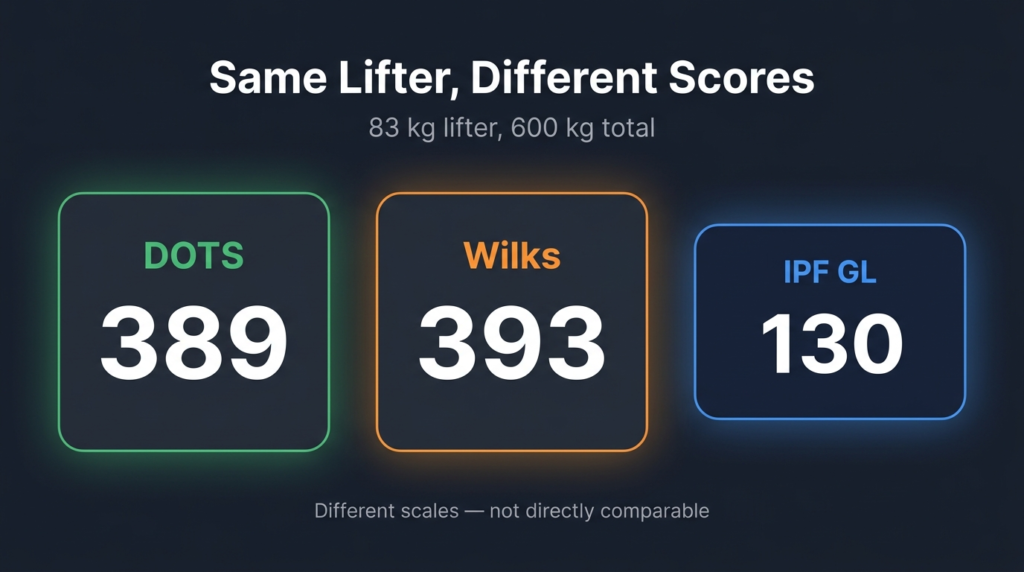
    A male lifter at 83 kg with a 600 kg total would score roughly 389 DOTS, around 393 Wilks, and approximately 130 IPF GL points. The three numbers are not on the same scale. IPF GL uses a completely different scoring range than DOTS or Wilks.

    infograph for Same Lifter, Different Scores

    Never compare your IPF GL points directly to your DOTS or Wilks score. They measure the same thing using entirely different scales.

    Which score is highest for most lifters

    Most lifters score slightly higher on Wilks than on DOTS at the same bodyweight and total. The gap is usually between 5 and 20 points, depending on where you sit on the bodyweight curve. IPF GL produces a much smaller number by design.

    Which formula should you actually use?

    The answer is simple: use whatever your federation uses officially. That is the only score that matters at your meet.

    If you train outside of competition and want a personal benchmark, DOTS is a good option. It gives a balanced view of strength across all body weights. If your federation uses Wilks, track Wilks. If you compete in an IPF affiliate, IPF GL is your number.

    Tracking multiple scores

    Many lifters track all three scores at the same time. This helps them see their strength across different systems. It also matters because federations and scoring methods can change over time. You can run all three scores on a calculator in just a few seconds. This shows exactly where you stand in each system. It also explains why your Wilks score can look different depending on which version is used.

    Does the formula choice affect your training?

    No. The goal is always the same: increase your total and manage your bodyweight. A stronger total produces a better score under every formula. No training strategy optimizes specifically for one scoring system over another.

    The formula mainly matters when you compare yourself to other lifters. It also matters when you check your ranking in a specific federation.

    Frequently asked questions

    Which is better, DOTS or Wilks?

    DOTS is more accurate across all body weights based on modern data. Wilks is more widely recognised historically. Use whichever your federation requires.

    Does IPF use DOTS or Wilks?

    Neither. The IPF has used IPF GL Points exclusively since 2020. DOTS and Wilks are used by non-IPF federations.

    Are DOTS and Wilks scores the same number?

    No. The same lifter will get different numbers under each formula. They are not directly comparable to each other.

    Which scoring system is most accurate?

    IPF GL ranked first in the IPF’s 2020 evaluation within its own data. DOTS ranked second and performed most consistently across all federations and bodyweights.

    Can I use all three calculators on the same tool?

    Yes. Enter your bodyweight and total into the scoring calculator on this page to get your DOTS, Wilks, and reference scores instantly.

    Worth Knowing

    No formula is perfect. Every scoring system is a mathematical approximation of a complex physical reality. What matters more than which formula you use is the direction your score moves over time.

    Pick the system your federation uses, track it consistently, and focus on moving the number upward each training block.

  • Wilks2 in Powerlifting: What Changed in the 2020 Formula Update

    Wilks2 in Powerlifting: What Changed in the 2020 Formula Update

    You open a powerlifting calculator and see two options: Wilks and Wilks2.

    Most lifters pick one without knowing what separates them. The difference matters more than you think.

    What is Wilks2?

    Wilks2 is an updated version of the original Wilks formula, released in March 2020. Robert Wilks rebuilt it using newer competition data to fix the issues in the 1995 version. The way the formula works stayed the same, but the numbers inside it were updated.

    The quick answer

    Wilks2 is the 2020 update of the Wilks scoring formula. It gives more accurate strength scores than the original, especially for very light and very heavy lifters.

    Why did the Wilks formula need an update?

    The original Wilks formula was built on 1995 competition records. The sport grew enormously over the following 25 years. The dataset behind the original formula could not represent modern powerlifting populations accurately.

    The most documented problem was bias at extreme body weights. Very light lifters were underscored. Very heavy lifters were overscored in some weight ranges. Middleweight male lifters had an unfair advantage. This advantage was not based on their actual strength.

    infograph for A smooth line graph representing scoring fairness across bodyweight

    What the data showed

    In early 2020, the International Powerlifting Federation reviewed several scoring formulas. They checked how fair each formula was across different weight classes. They also looked at how well it ranked lifters based on real performance. The original Wilks formula did not perform well at very low and very high body weights. It was clear that an update was needed.

    What exactly changed in Wilks2?

    The core structure of Wilks2 is identical to the original. Both use a fifth-degree polynomial equation. Both multiply your powerlifting total by a bodyweight coefficient. The difference is in the specific constants used inside that polynomial.

    Robert Wilks updated the formula using more recent competition data. He used a larger set of results to make it more accurate. The new constants produce a smoother coefficient curve. Scores for lifters at extreme bodyweights shifted noticeably. Scores for middle bodyweight lifters changed by a smaller margin.

    How much do the scores differ?

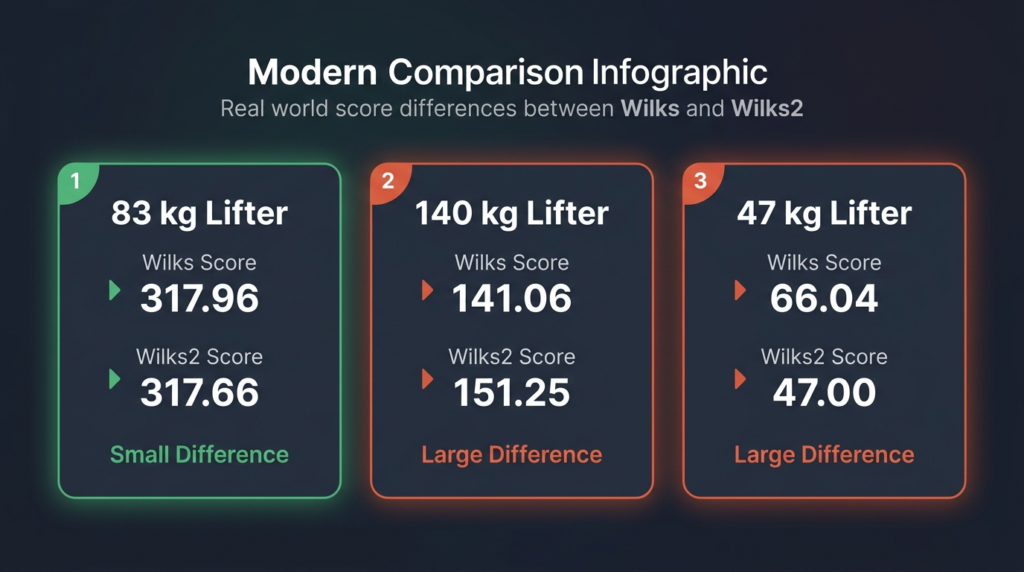
    For a male lifter at 83 kg, the difference between Wilks and Wilks2 is small, often just a few points. For a male lifter at 140 kg or a female lifter at 47 kg, the gap can be 15 to 30 points. The update matters most if you compete at the lighter or heavier end of the weight class spectrum.

    Is Wilks2 more accurate than the original Wilks?

    Yes, but with context. Wilks2 ranked third in the IPF’s 2020 formula evaluation. The original Wilks ranked last in several categories. DOTS ranked second. IPF GL Points ranked first overall.

    Wilks2 is a clear improvement over the original formula. It gives fairer results, especially for lifters at the extremes of body weight. However, it is not the most accurate system available today. If your federation still uses Wilks, the 2020 version is a better option than the old one.

    To see how it compares with newer systems, check a full comparison of all major scoring formulas side by side.

    Who uses Wilks2 today?

    Powerlifting Australia is the most prominent federation using Wilks2 as its official scoring system. Several smaller national federations have also adopted it. Most major federations that moved away from the original Wilks chose DOTS rather than Wilks2.

    Why most federations skipped Wilks2

    The IPF had already developed its own replacement by the time Wilks2 was published. Non-IPF federations such as USPA and WRPF moved to DOTS around the same time. Wilks2 arrived during a moment when the sport was already splitting into two camps: IPF GL and DOTS. There was little room left for a third option.

    Can you compare Wilks and Wilks2 scores directly?

    No, you cannot compare them directly. Both formulas give different scores for the same lifter. So, a 390 on the original Wilks is not the same as a 390 on Wilks2. If your federation switched from Wilks to Wilks2, your old scores and new scores will not match. Because of this, they should not be compared directly over time. Always note which version was used when recording your score. The difference is small for most lifters but real enough to matter at the competitive level.

    Which version should you calculate?

    Use the formula your federation uses in competition. That is the one that matters most. For personal tracking, Wilks2 gives a more accurate picture of your strength than the original. You can also run both versions to see how your score changes between them. The full history of these formulas explains why the 1995 version was used for so long before it was updated.

    Frequently asked questions

    What is Wilks2 in powerlifting?

    Wilks2 is the 2020 updated version of the original Wilks formula. It uses recalibrated constants to produce fairer scores at extreme body weights.

    Is Wilks2 better than the original Wilks?

    Yes. Wilks2 corrects known biases in the 1995 formula. It scores lifters more accurately at very light and very heavy bodyweights.

    Who uses Wilks2?

    Powerlifting Australia is the main federation using Wilks2 officially. Most other federations moved to DOTS or IPF GL Points instead.

    Is Wilks2 the same as DOTS?

    No. Wilks2 is a revised version of the Wilks formula. DOTS is a completely separate formula built by a different person using a different mathematical approach.

    How much does my score change between Wilks and Wilks2?

    For most lifters in middleweight classes, the difference is under 10 points. At extreme body weights, the gap can reach 15 to 30 points.

    Bottom Line

    Wilks2 is a better version of the original Wilks formula. It fixes real scoring problems without changing the fundamental approach. Whether it matters to you depends entirely on which federation you compete in.

    Pull up the calculator and run your numbers under both Wilks versions to see exactly how they compare for your body weight and total.