Most lifters know their DOTS score. However, few of them understand how it is calculated. When you understand the formula, you can make better choices. It also helps you plan your training and pick the right weight class.
What is the DOTS score formula?
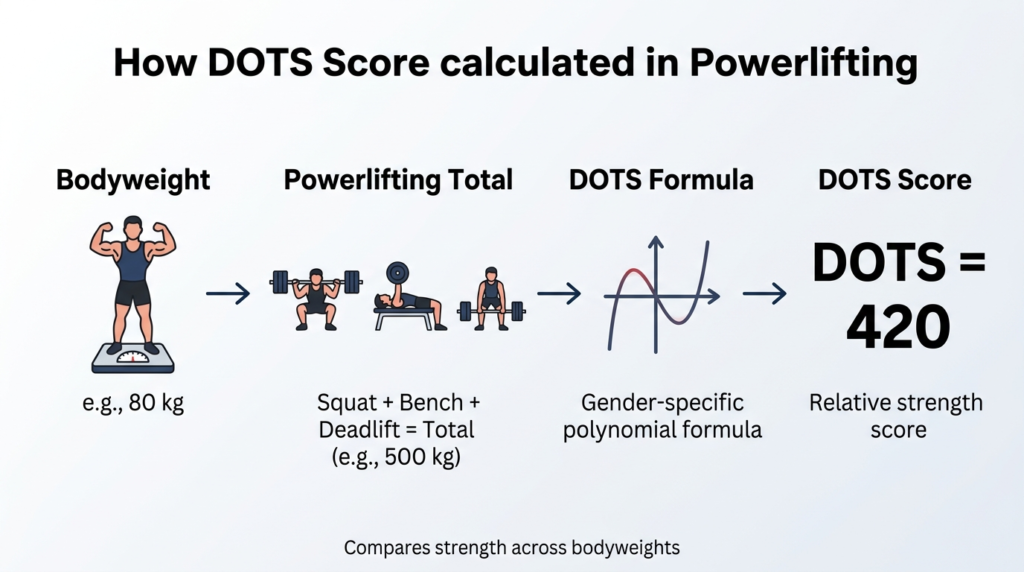
The DOTS score formula multiplies your powerlifting total by a bodyweight coefficient. That coefficient comes from a fifth-degree polynomial equation. It changes continuously with every kilogram of body weight. The result is one number that reflects your strength relative to your size.
The full formula looks like this:
DOTS Score = Total (kg) × (500 ÷ D)
Where D is calculated based on your body weight using gender-specific constants.
You do not need to solve this equation by hand. The DOTS calculator handles the full calculation instantly.
What inputs does the formula need?
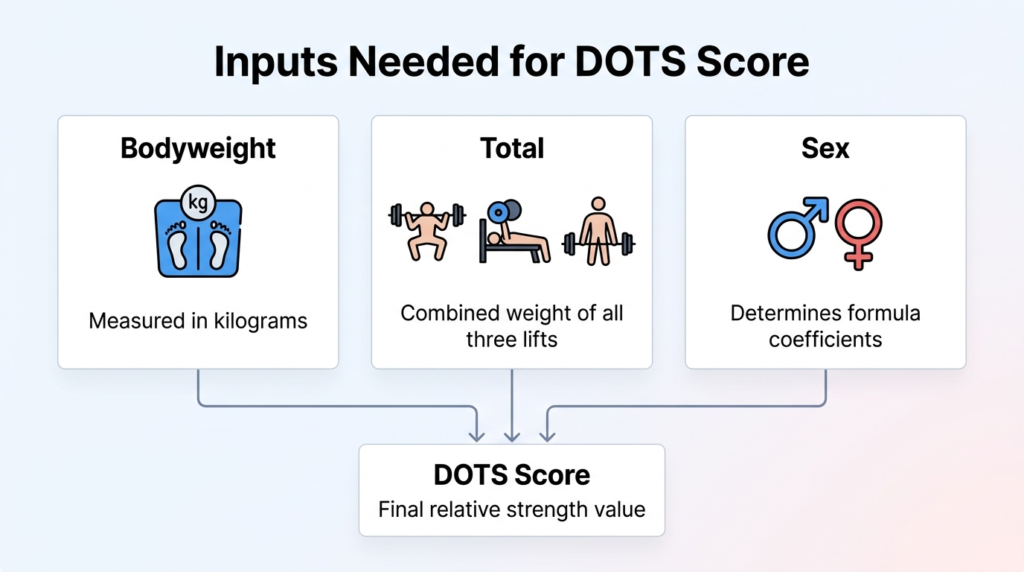
The DOTS formula needs only three inputs, which are your bodyweight in kilograms, your powerlifting total in kilograms, and your sex. It does not include age, height, or equipment type.
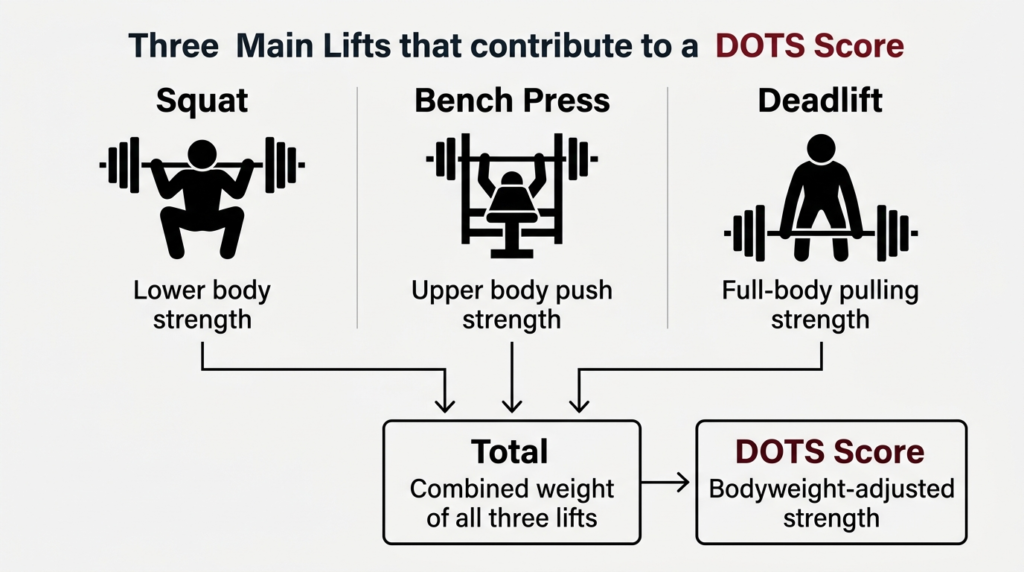
Your total is the sum of your best squat, bench press, and deadlift. All three lifts are required. A missing lift means no valid total and no valid score.
How is the powerlifting total calculated?
Add your best squat, bench press, and deadlift together. A lifter who squats 180 kg, bench presses 120 kg, and deadlifts 220 kg has a total of 520 kg. That total goes directly into the DOTS formula alongside bodyweight.
Why does bodyweight change the coefficient?
Strength does not increase at the same rate as body weight. If lifters gain 10 kg of body weight, they do not gain 10 kg in lifting strength. It does not work that way. The DOTS formula uses a curve to reflect this real-life behavior. It adjusts scores based on how the strength actually grows. That is why heavier lifters get a slightly lower coefficient. Their higher body weight already gives them an advantage in total weight lifted.
Male vs. female coefficients: What is different?
The DOTS formula uses different constants for male and female lifters. This is because their strength changes differently as body weight increases. Each group follows its own pattern. Even with these differences, the scores are on the same scale. For example, a score of 380 means the same level of strength for both. A female lifter with 380 is just as strong, relatively, as a male lifter with 380.
What bodyweight limits apply to the formula?
The DOTS formula only works within certain weight ranges. For male lifters, it is valid from 40 kg to 210 kg. And for female lifters, it is valid from 40 kg to 150 kg. Outside these ranges, there was not enough data to build accurate results. Therefore, scores calculated beyond these limits are not reliable. They also should not be used for official comparisons.
How does a worked example look?
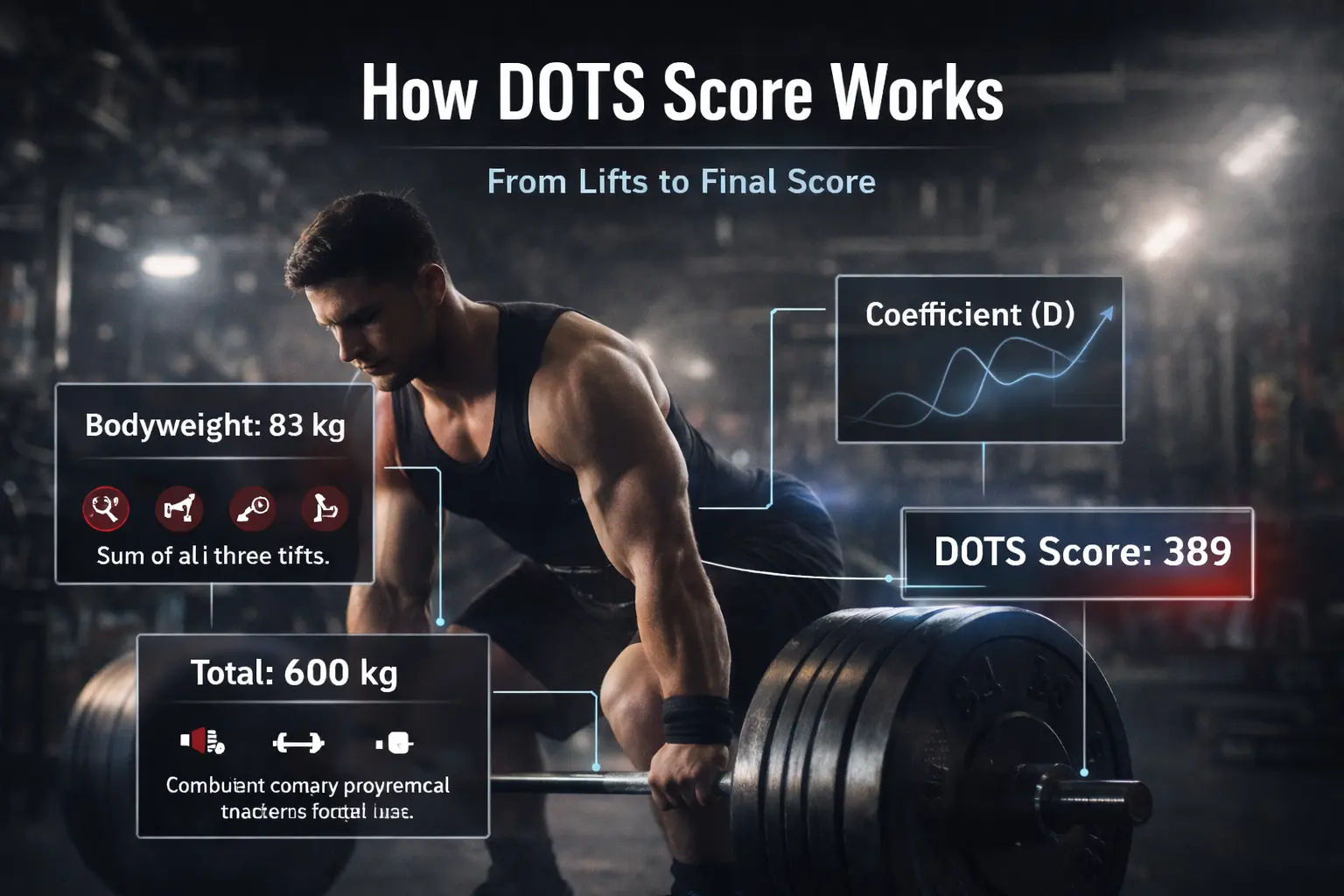
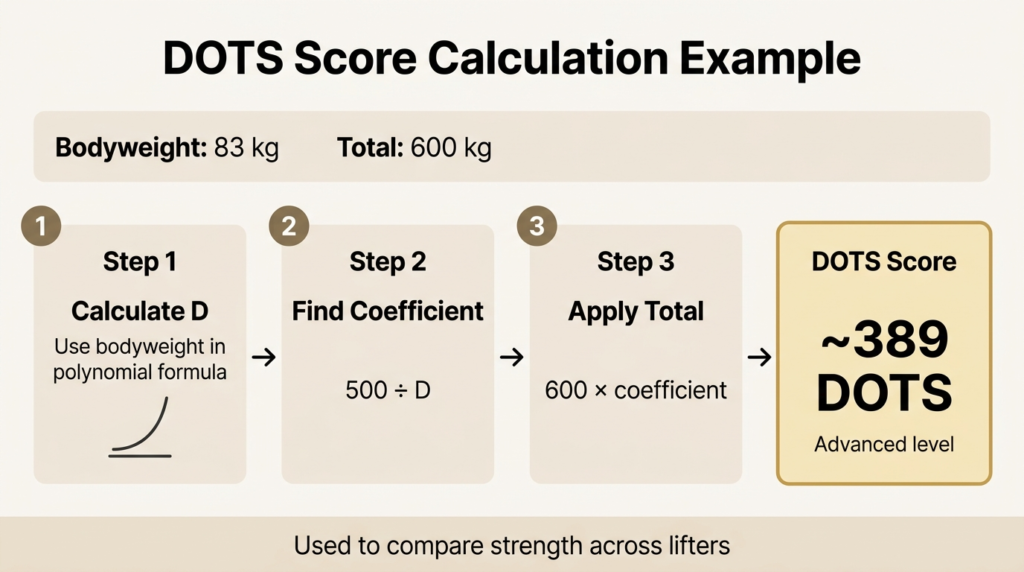
Take a male lifter weighing 83 kg with a total of 600 kg.
Step 1: Plug 83 into the male polynomial to obtain the denominator D. Step 2: Divide 500 by D to get the coefficient. Step 3: Multiply 600 by that coefficient.
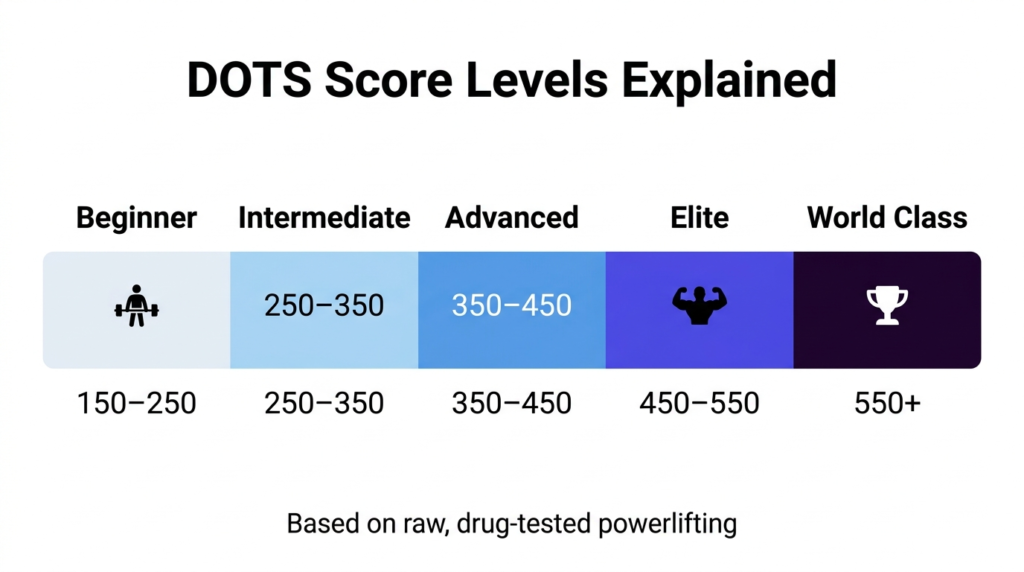
The result comes out to around 389 DOTS. This score falls in the advanced range. If you want to understand what that means for your level, check the full benchmark table. It shows what counts as a good DOTS score.
Does equipment type affect the score?
The DOTS formula itself does not change for equipped lifting. It uses the same calculation regardless of whether you lifted raw or in a squat suit. However, equipped lifters produce higher totals because of the gear assistance. That inflates the score compared to raw lifters at the same bodyweight. Most federations apply DOTS only to raw divisions for best lifter purposes.
What data was the formula built on?
Tim Konertz created the DOTS formula in 2019. He used competition data from elite powerlifters around the world, across all weight classes. He applied a mathematical method called polynomial regression. This helped him build a curve that shows how strength changes with body weight in real competitions. In 2020, the British Powerlifting Federation reviewed several scoring systems. DOTS ranked second overall. It performed very well for accuracy and fairness across different weight classes.
Frequently asked questions
How is the DOTS score calculated in powerlifting?
The DOTS score is calculated using your total weight lifted and your body weight. First, you add up all three lifts. This includes the squat, bench press, and deadlift. Then, this total is multiplied by a bodyweight coefficient. That coefficient comes from a formula based on your sex. It adjusts the score to keep things fair across different body weights. So, the calculation needs three inputs, such as your body weight, the total lifted, and your sex.
Can I calculate my DOTS score in pounds?
The DOTS formula works in kilograms only. If your lifts are in pounds, you would normally convert them first. A simple way is to divide by 2.2046. But you don’t need to worry about that most of the time. Most DOTS calculators accept pounds and convert them for you automatically. In this way, you just enter your numbers and get a score.
What happens if I only have two lifts?
A DOTS score needs all three lifts. You must have a squat, bench press, and deadlift. These three together make your total. If even one lift is missing, your total is incomplete. And without a total, you cannot get a DOTS score. If you only train two lifts, the result will not be valid for competition or fair comparison.
Does bodyweight affect the DOTS score more than total?
Yes, both bodyweight and total matter. However, your total has a bigger impact on your score. For example, whenever you double your total, your DOTS score also doubles. It changes directly with how much you lift. Bodyweight works differently. It adjusts the coefficient, which only shifts your score slightly up or down. In short, the best way to increase your DOTS score is to focus on lifting more weight, not just reducing your bodyweight.
Is the DOTS score the same across all federations?
Yes, the DOTS formula is the same wherever it is used. However, not every federation uses DOTS. For instance, the International Powerlifting Federation uses a different system called IPF GL Points. That is why you should always check your federation’s scoring system before you compete.
The bottom line
The DOTS score comes down to two things: your total and your body weight. The polynomial does the rest.
Skip the manual math. Enter your lifts into the DOTS calculator and get your score in seconds.